Move to inspect
Tetrasubstituted GHRH Receptor Agonist
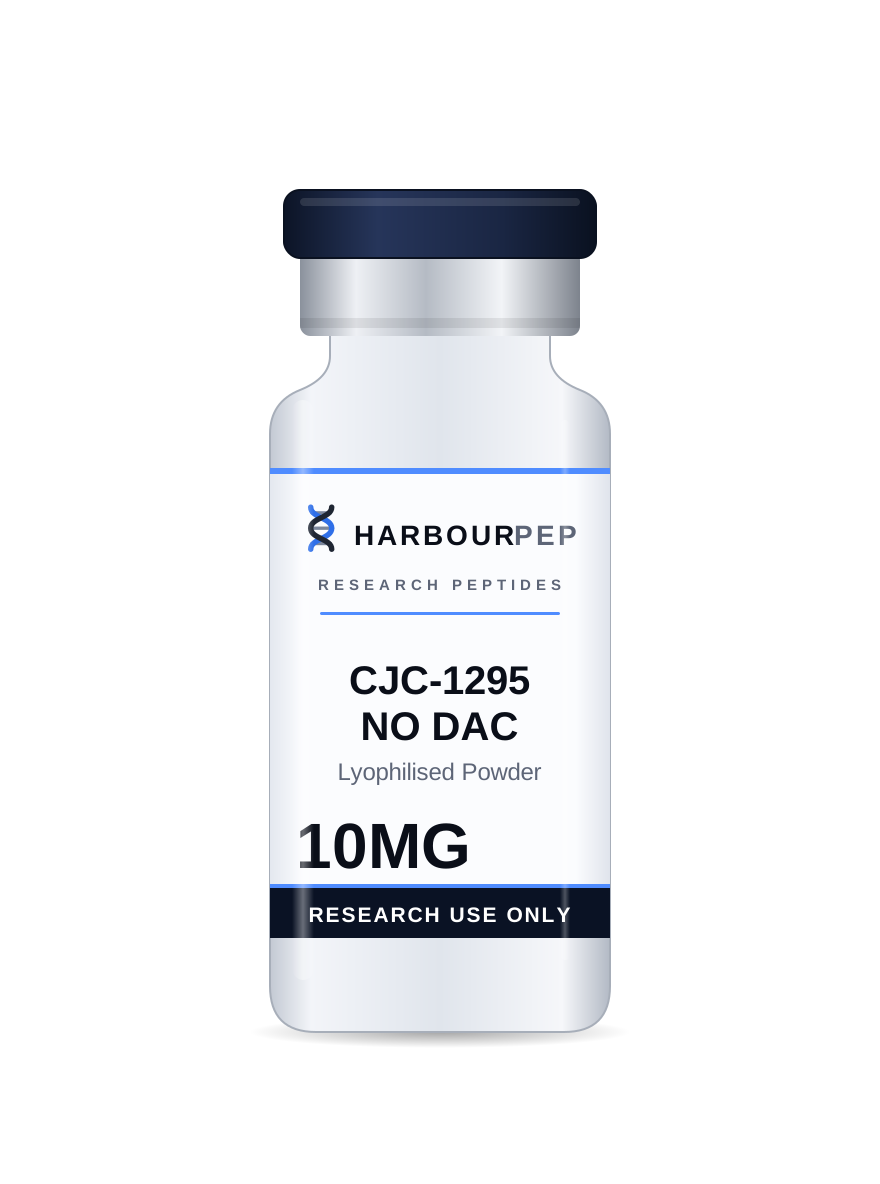
CJC-1295 No DAC
10MG per vial
CJC-1295 No DAC, catalogued in the literature as Modified GRF (1-29), is a synthetic 29-residue analogue of the bioactive N-terminal fragment of human growth hormone-releasing hormone. It is C-terminally amidated and carries four substitutions relative to the native sequence: D-Ala at position 2, Gln for Asn at 8, Ala for Gly at 15 and Leu for Met at 27 — the first blocking dipeptidyl peptidase-4 cleavage, the second removing an asparagine deamidation site and the fourth removing the oxidation-labile methionine. It is an agonist at the growth hormone-releasing hormone receptor (GHRHR), a class B G protein-coupled receptor on anterior pituitary somatotrophs that couples through Gαs to adenylyl cyclase, raising intracellular cAMP and activating protein kinase A.
Coming soon
Ask us when it returns
Pricing on request
Prices are still being set. Add what you need to your cart and request a quote from there — we will come back with current pricing and availability, usually within one business day.
Research use only. Supplied for in vitro laboratory research. Not a drug, supplement, cosmetic or medical device, not approved by the TGA, and not for administration to humans or animals. See our research use conditions.
Compound signature
From confirmed structure
3368g/mol
Molar mass
238atoms
Heavy atoms
Atomic composition
C152H252N44O42
- C152
- H252
- N44
- O42
Characterised targets
- GHRHR
Sequence
Tyr-D-Ala-Asp-Ala-Ile-Phe-Thr-Gln-Ser-Tyr-Arg-Lys-Val-Leu-Ala-Gln-Leu-Ser-Ala-Arg-Lys-Leu-Leu-Gln-Asp-Ile-Leu-Ser-Arg-NH2
Research applications
The parent compound CJC-1295 extends the same tetrasubstituted backbone with a thirtieth residue, lysine, whose side-chain amine carries a maleimidopropionyl group; this maleimide reacts with Cys34 of serum albumin to form a covalent conjugate. The present molecule omits that lysine and linker entirely, and the pair has been utilised to separate GHRHR receptor pharmacology from carrier-mediated plasma residence. In vitro work with pituitary cell preparations and GHRHR-expressing lines has characterised cAMP accumulation and CREB phosphorylation downstream of receptor occupancy, together with the transcriptional arm running through Pit-1 to the GH gene. Because the albumin conjugate persists in circulation on a multi-day timescale while the unconjugated analogue does not, cell and rodent studies have used the two side by side to examine episodic rather than continuous receptor stimulation. The unconjugated form is also frequently co-applied with ghrelin receptor (GHS-R1a) agonists such as ipamorelin or GHRP-6, which engage an entirely separate receptor, in designs intended to probe the interaction between the two secretagogue pathways.
Formulation and handling
Supplied as a lyophilised cake; the C-terminal amide blocks carboxypeptidase trimming and the D-Ala2 residue blocks DPP-4 cleavage at the N-terminus, making the chain more resistant to exopeptidase attack than native GHRH(1-29), but it remains a 29-residue, arginine- and lysine-rich peptide that adsorbs to glass and polypropylene from dilute solution. Introduce diluent slowly down the vial wall rather than directly onto the cake and swirl rather than vortex, since shearing and foaming are the principal causes of recovery loss with chains of this length.
Intended use
CJC-1295 No DAC is supplied exclusively for in vitro and non-clinical scientific research. It is not approved for human or animal therapeutic, diagnostic or medicinal use. All handling and experimentation must be carried out by trained personnel in an appropriately controlled laboratory.
Specification
- Presentation
- Vial
- Labelled strength
- 10MG
- Molecular formula
- C152H252N44O42
- Molar mass
- 3367.9 g/mol
- Molecular targets
- GHRHR
- Appearance
- Lyophilised powder
- Storage
- 2–8 °C sealed, −20 °C long term
Values describe the compound as supplied. Analytical figures for the material in your vial are on that lot’s certificate, not here.
Certificates of analysis
None published yetEvery lot is tested by an independent laboratory and carries its own certificate. Match the lot number printed on your vial to the certificate — a certificate for a different lot tells you nothing about yours.
Slot 1
Awaiting upload
The certificate for the next tested lot will appear here. Until then, ask us for the one matching your vial.
Slot 2
Awaiting upload
The certificate for the next tested lot will appear here. Until then, ask us for the one matching your vial.
Slot 3
Awaiting upload
The certificate for the next tested lot will appear here. Until then, ask us for the one matching your vial.
Also in the range