Move to inspect
Copper(II)-Binding Tripeptide Complex
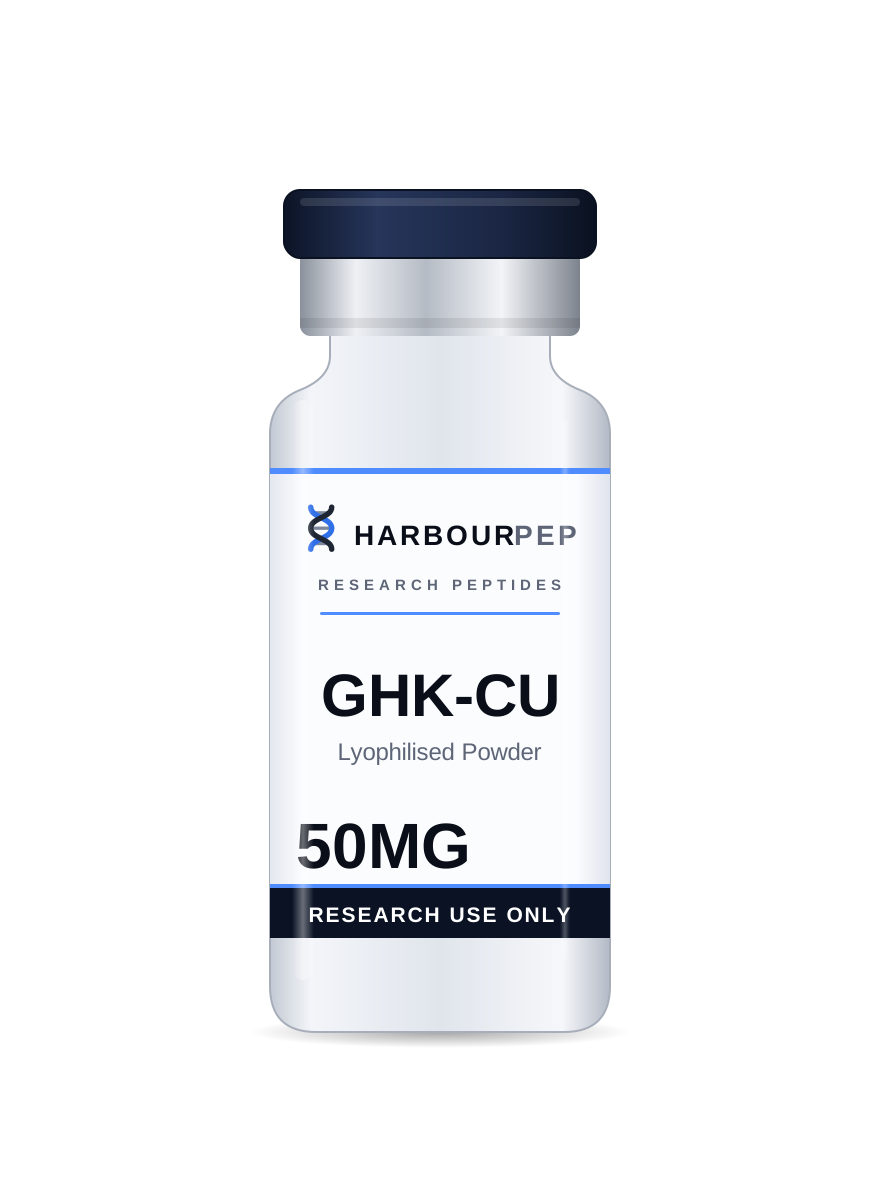
GHK-Cu
50MG per vial
GHK-Cu is the 1:1 coordination complex of the tripeptide glycyl-L-histidyl-L-lysine with a copper(II) ion, first isolated in 1973 by Loren Pickart, who tracked it as an activity associated with human plasma albumin. Copper is held by three nitrogen donors — the glycine α-amino nitrogen, the deprotonated glycyl-histidyl amide nitrogen and an imidazole nitrogen of histidine — leaving one exchangeable coordination position; the complex is highly stable, with a reported log K of approximately 16.4, and holds copper in a state where its redox activity is quenched rather than free to drive Fenton chemistry. The same Gly-His-Lys motif is embedded in the α2(I) chain of type I collagen and in the matricellular glycoprotein SPARC, and proteolytic liberation from these matrix proteins at sites of remodelling is the prevailing account of the origin of endogenous GHK.
In stock
Available to ship today
Pricing on request
Prices are still being set. Add what you need to your cart and request a quote from there — we will come back with current pricing and availability, usually within one business day.
Research use only. Supplied for in vitro laboratory research. Not a drug, supplement, cosmetic or medical device, not approved by the TGA, and not for administration to humans or animals. See our research use conditions.
Compound signature
From confirmed structure
401.9g/mol
Molar mass
25atoms
Heavy atoms
Atomic composition
C14H22CuN6O4
- C14
- H22
- N6
- O4
- Cu1
Sequence
Gly-His-Lys (GHK)
Research applications
Transcriptome profiling by Pickart and colleagues reported GHK modulating expression of at least four thousand human genes, with narrower follow-up analyses covering DNA-repair gene sets, TGF-β pathway activity in lung fibroblasts from donors with COPD, and a panel of 54 genes overexpressed in aggressive metastatic colon cancer assayed at around 1 μM. In dermal fibroblast culture at nanomolar concentrations, investigators have characterised synthesis of collagen and of glycosaminoglycans including dermatan and chondroitin sulfate, production of the small proteoglycan decorin, and the balance between matrix metalloproteinase activity and the inhibitors TIMP-1 and TIMP-2. Three-dimensional skin-equivalent models have been used to track integrin and p63 expression in the basal keratinocyte layer across a 0.1–10 μM range, while a separate design in which GHK was covalently coupled to alginate hydrogels has been used to measure VEGF and basic FGF secretion from entrapped mesenchymal stem cells — a response abolished when the cells were pre-treated with blocking antibodies against integrins α6 and β1. Wound models in rabbits, rats, mice, pigs and dogs have been utilised to examine granulation, neovascularisation, collagen deposition and tissue antioxidant enzyme levels.
Formulation and handling
This is a metal complex rather than a bare peptide: it presents as a deep blue to blue-violet lyophilised solid and reconstitutes to an intensely blue solution, and that colour is the d-d absorption of coordinated Cu(II), making it a direct visual readout of complex integrity — fading to pale, green or colourless indicates the copper has been displaced. Reconstitute with a near-neutral diluent rather than an acidified one, since low pH protonates the amide and imidazole donors and dissociates the complex, and keep solutions out of direct light, as the copper centre makes this more photosensitive than an uncomplexed peptide.
Intended use
GHK-Cu is supplied exclusively for in vitro and non-clinical scientific research. It is not approved for human or animal therapeutic, diagnostic or medicinal use. All handling and experimentation must be carried out by trained personnel in an appropriately controlled laboratory.
Specification
- Presentation
- Vial
- Labelled strength
- 50MG
- Molecular formula
- C14H22CuN6O4
- Molar mass
- 401.9 g/mol
- CAS number
- 89030-95-5
- Appearance
- Lyophilised powder
- Storage
- 2–8 °C sealed, −20 °C long term
Values describe the compound as supplied. Analytical figures for the material in your vial are on that lot’s certificate, not here.
Certificates of analysis
None published yetEvery lot is tested by an independent laboratory and carries its own certificate. Match the lot number printed on your vial to the certificate — a certificate for a different lot tells you nothing about yours.
Slot 1
Awaiting upload
The certificate for the next tested lot will appear here. Until then, ask us for the one matching your vial.
Slot 2
Awaiting upload
The certificate for the next tested lot will appear here. Until then, ask us for the one matching your vial.
Slot 3
Awaiting upload
The certificate for the next tested lot will appear here. Until then, ask us for the one matching your vial.
Also in the range