Move to inspect
EPO Helix-B Innate Repair Agonist
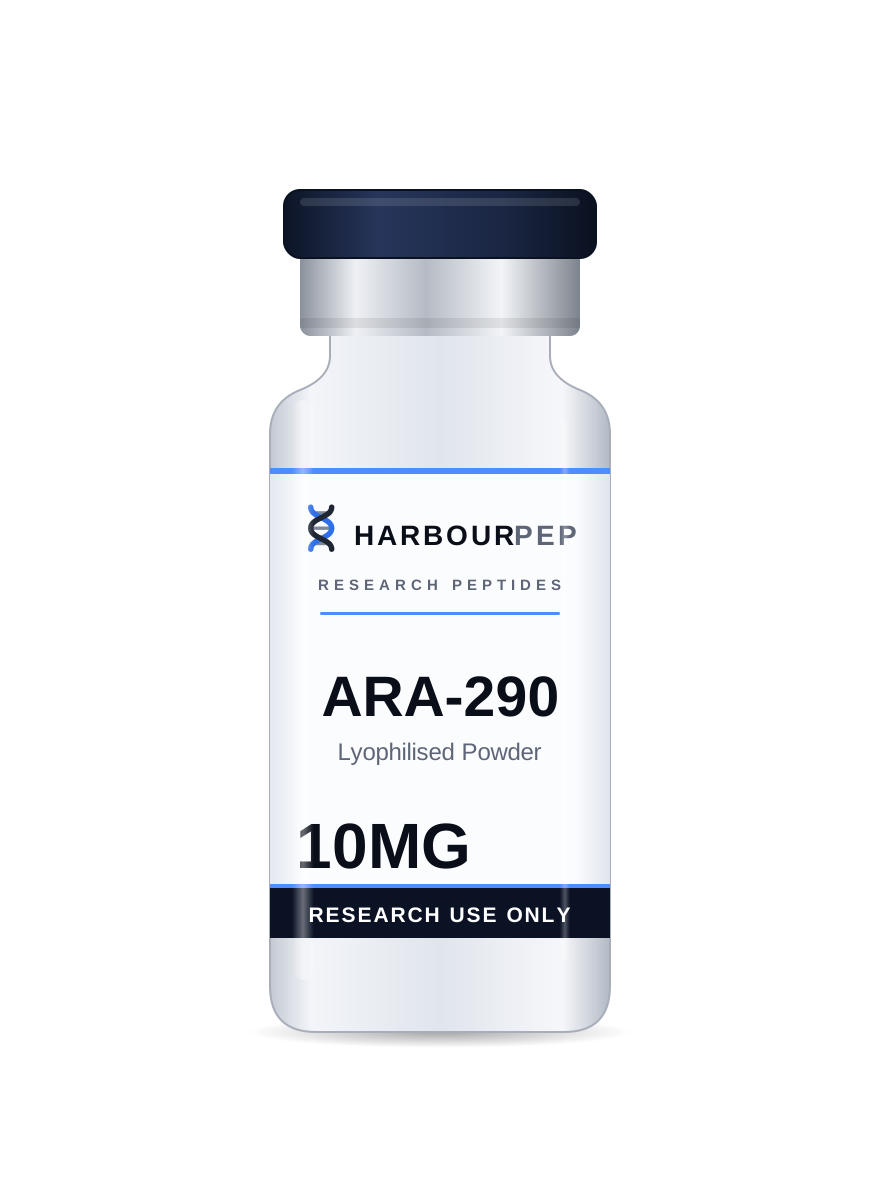
ARA-290
10MG per vial
ARA-290 (cibinetide) is an 11-residue synthetic peptide reproducing the aqueous-exposed face of helix B of human erythropoietin, with the N-terminal glutamine cyclised to pyroglutamate. It was designed by Brines and Cerami at Araim Pharmaceuticals to separate erythropoietin's tissue-protective signalling from its erythropoietic signalling, two activities entangled in the parent hormone. The fragment engages the heterodimer of the erythropoietin receptor with the beta-common receptor (CD131), together termed the innate repair receptor, rather than the EPOR homodimer that drives red cell production.
In stock
Available to ship today
Pricing on request
Prices are still being set. Add what you need to your cart and request a quote from there — we will come back with current pricing and availability, usually within one business day.
Research use only. Supplied for in vitro laboratory research. Not a drug, supplement, cosmetic or medical device, not approved by the TGA, and not for administration to humans or animals. See our research use conditions.
Compound signature
From confirmed structure
1257g/mol
Molar mass
88atoms
Heavy atoms
Atomic composition
C51H84N16O21
- C51
- H84
- N16
- O21
Characterised targets
- EPOR
- CD131 (beta-common receptor)
Sequence
pGlu-Glu-Gln-Leu-Glu-Arg-Ala-Leu-Asn-Ser-Ser (pGlu-EQLERALNSS)
Research applications
The innate repair receptor is induced locally on stressed, injured or inflamed tissue rather than being constitutively expressed, which makes ARA-290 a useful probe for signalling restricted to damaged tissue instead of acting systemically. Receptor engagement has been characterised in vitro as coupling through JAK2 phosphorylation to STAT and PI3K-Akt signalling. Rodent work has characterised the peptide in models of diabetic small nerve fibre loss and in inflammatory and ischaemic injury models. Because the peptide is non-erythropoietic by design, haematocrit and reticulocyte counts are commonly measured as a negative control confirming dissociation from classical EPO signalling. The compound has also progressed into clinical investigation in sarcoidosis-associated small-fibre neuropathy.
Formulation and handling
Supplied as a lyophilised powder and freely soluble in aqueous buffer, given the high proportion of charged glutamate and arginine residues alongside two serines. The N-terminal pyroglutamate is a blocked terminus, so Edman degradation will not read the sequence — mass spectrometry, or enzymatic deblocking with pyroglutamate aminopeptidase, is required for analytical confirmation.
Intended use
ARA-290 is supplied exclusively for in vitro and non-clinical scientific research. It is not approved for human or animal therapeutic, diagnostic or medicinal use. All handling and experimentation must be carried out by trained personnel in an appropriately controlled laboratory.
Specification
- Presentation
- Vial
- Labelled strength
- 10MG
- Molecular formula
- C51H84N16O21
- Molar mass
- 1257.3 g/mol
- CAS number
- 1208243-50-8
- Molecular targets
- EPOR, CD131 (beta-common receptor)
- Appearance
- Lyophilised powder
- Storage
- 2–8 °C sealed, −20 °C long term
Values describe the compound as supplied. Analytical figures for the material in your vial are on that lot’s certificate, not here.
Certificates of analysis
None published yetEvery lot is tested by an independent laboratory and carries its own certificate. Match the lot number printed on your vial to the certificate — a certificate for a different lot tells you nothing about yours.
Slot 1
Awaiting upload
The certificate for the next tested lot will appear here. Until then, ask us for the one matching your vial.
Slot 2
Awaiting upload
The certificate for the next tested lot will appear here. Until then, ask us for the one matching your vial.
Slot 3
Awaiting upload
The certificate for the next tested lot will appear here. Until then, ask us for the one matching your vial.
Also in the range