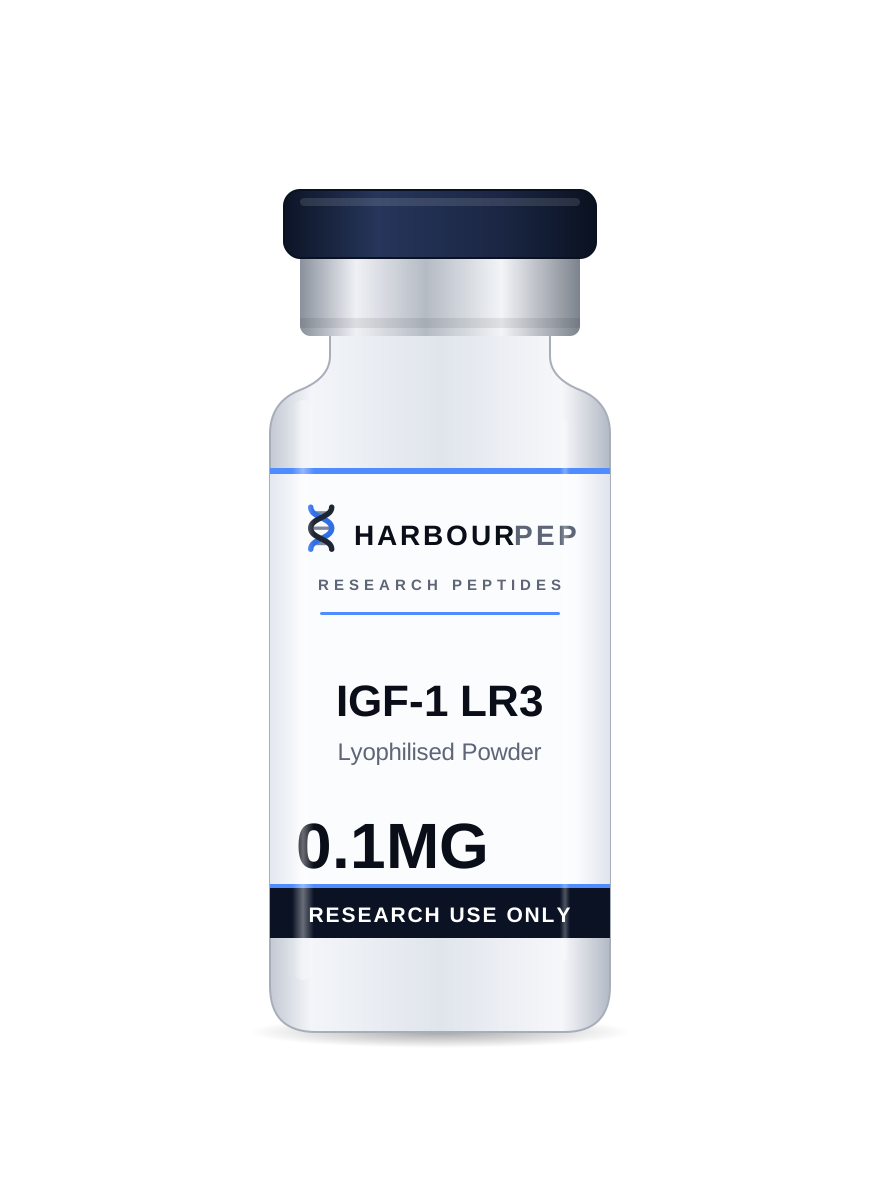
Move to inspect
IGFBP-Resistant IGF-1 Receptor Agonist
IGF-1 LR3
0.1MG per vial
IGF-1 LR3 is a recombinant 83-residue analogue of human insulin-like growth factor 1, carrying two deliberate departures from the native 70-residue protein: a glutamate-to-arginine substitution at position 3, and a 13-residue N-terminal extension (MFPAMPLSSLFVN) derived from methionyl porcine growth hormone. Both modifications sit in the region mediating contact with the insulin-like growth factor binding proteins, and together they sharply reduce affinity for IGFBP-1 through IGFBP-6 — figures quoted in the literature range from roughly two orders of magnitude to over 1000-fold — while leaving high-affinity binding to the type 1 IGF receptor essentially intact. The consequence is a ligand that is not sequestered by the IGFBPs present in serum or secreted by cultured cells, so a far larger free fraction reaches IGF-1R and engages the PI3K/Akt and Ras–MAPK cascades.
In stock
Available to ship today
Pricing on request
Prices are still being set. Add what you need to your cart and request a quote from there — we will come back with current pricing and availability, usually within one business day.
Research use only. Supplied for in vitro laboratory research. Not a drug, supplement, cosmetic or medical device, not approved by the TGA, and not for administration to humans or animals. See our research use conditions.
Compound signature
From confirmed structure
9118g/mol
Molar mass
635atoms
Heavy atoms
Atomic composition
C400H625N111O115S9
- C400
- H625
- N111
- O115
- S9
Characterised targets
- IGF-1R
- IGFBP-1 to IGFBP-6 (markedly reduced affinity)
Sequence
MFPAMPLSSLFVNGPRTLCGAELVDALQFVCGDRGFYFNKPTGYGSSSRRAPQTGIVDECCFRSCDLRRLEMYCAPLKPAKSA
Research applications
Its best-documented laboratory use is as a defined supplement in serum-free and reduced-serum cell culture, particularly in CHO and hybridoma bioprocessing, where it substitutes for insulin at far lower molar concentrations and is studied for its effect on proliferation rate, viable-cell density and the onset of apoptosis in fed-batch culture. Because IGFBP sequestration confounds concentration–response work with native IGF-1, LR3 is also used as a tool ligand for isolating receptor-level IGF-1R signalling from binding-protein behaviour in myoblast, chondrocyte and neuronal culture models. Rodent studies have used it to examine IGF-1 axis contributions to tissue growth endpoints independently of hepatic IGFBP-3 and acid-labile subunit dynamics.
Formulation and handling
Produced recombinantly in E. coli and supplied lyophilised; unlike the small synthetic peptides in the catalogue it is a disulfide-bonded protein with three intramolecular bridges, so activity depends on correct folding and it tolerates repeated freeze-thaw poorly. Solubility is poor near neutral pH — it is conventionally reconstituted in dilute acid, commonly 10 mM HCl or dilute acetic acid, before dilution into buffer — and at low concentrations it adsorbs appreciably to glass and plastic, which is why carrier protein is added to dilute working stocks.
Intended use
IGF-1 LR3 is supplied exclusively for in vitro and non-clinical scientific research. It is not approved for human or animal therapeutic, diagnostic or medicinal use. All handling and experimentation must be carried out by trained personnel in an appropriately controlled laboratory.
Specification
- Presentation
- Vial
- Labelled strength
- 0.1MG
- Molecular formula
- C400H625N111O115S9
- Molar mass
- 9117.6 g/mol (reduced form)
- CAS number
- 946870-92-4
- Molecular targets
- IGF-1R, IGFBP-1 to IGFBP-6 (markedly reduced affinity)
- Appearance
- Lyophilised powder
- Storage
- 2–8 °C sealed, −20 °C long term
Values describe the compound as supplied. Analytical figures for the material in your vial are on that lot’s certificate, not here.
Certificates of analysis
None published yetEvery lot is tested by an independent laboratory and carries its own certificate. Match the lot number printed on your vial to the certificate — a certificate for a different lot tells you nothing about yours.
Slot 1
Awaiting upload
The certificate for the next tested lot will appear here. Until then, ask us for the one matching your vial.
Slot 2
Awaiting upload
The certificate for the next tested lot will appear here. Until then, ask us for the one matching your vial.
Slot 3
Awaiting upload
The certificate for the next tested lot will appear here. Until then, ask us for the one matching your vial.
Also in the range