Move to inspect
GHK-Cu, BPC-157, TB-500 and KPV
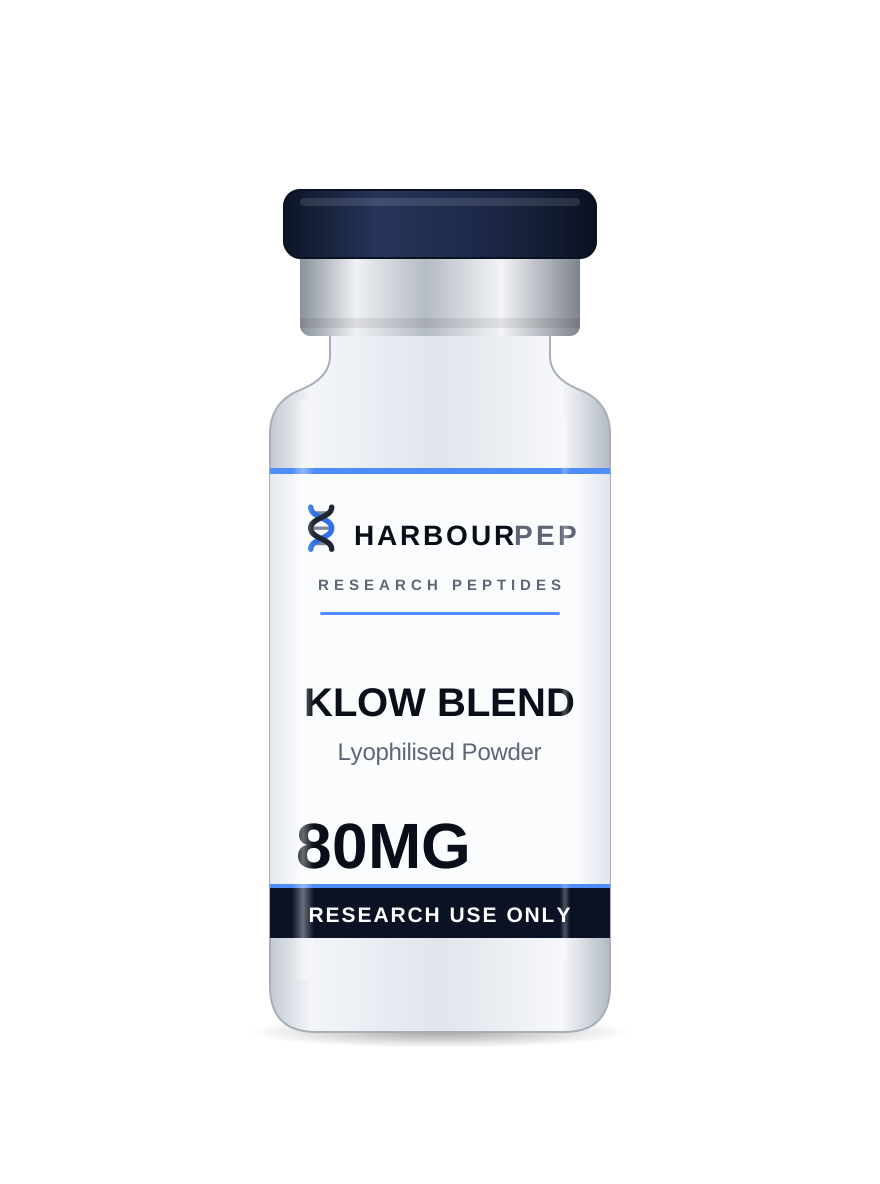
KLOW Blend
80MG per vial
KLOW is not a single molecule but a co-lyophilised four-component blend: GHK-Cu (the copper(II) complex of glycyl-L-histidyl-L-lysine), BPC-157 (the pentadecapeptide GEPPPGKPADDAGLV), TB-500 (conventionally the acetylated actin-binding heptapeptide Ac-LKKTETQ, corresponding to residues 17–23 of thymosin β4) and KPV (the α-MSH C-terminal tripeptide Lys-Pro-Val). The four constituents have distinct and non-overlapping characterised mechanisms — copper coordination and matrix gene regulation, angiogenic signalling described in terms of VEGFR2 expression, G-actin sequestration, and inhibition of NF-κB signalling respectively — and share no common receptor or pathway. The relative proportions of the four components are fixed at manufacture and stated on the product listing and certificate.
In stock
Available to ship today
Pricing on request
Prices are still being set. Add what you need to your cart and request a quote from there — we will come back with current pricing and availability, usually within one business day.
Research use only. Supplied for in vitro laboratory research. Not a drug, supplement, cosmetic or medical device, not approved by the TGA, and not for administration to humans or animals. See our research use conditions.
Compound signature
From confirmed structure
Characterised targets
- G-actin (β-thymosin actin-sequestering motif, TB-500)
- PepT1 (SLC15A1) (KPV uptake route)
Research applications
Each constituent carries a separate literature. GHK was isolated from human plasma by Pickart in 1973 and GHK-Cu has been characterised in fibroblast culture as a modulator of collagen and glycosaminoglycan synthesis and of the matrix metalloproteinase/TIMP balance, with transcriptomic work reporting changes across large numbers of genes. BPC-157 has been studied almost entirely in rodent injury models by Sikirić and colleagues; the mechanistic account centres on upregulated VEGFR2 expression and receptor internalisation with downstream Akt–eNOS signalling, and on a VEGF-independent Src–caveolin-1–eNOS route, though no receptor for BPC-157 itself has been identified and human data remain limited. TB-500 corresponds to the actin-binding motif of thymosin β4 and is examined for G-actin sequestration and its consequences for cell migration, and KPV has been characterised in colonic epithelial and T-cell lines as an inhibitor of NF-κB nuclear translocation. No peer-reviewed work characterises this specific four-way combination — the pharmacology available is that of the individual constituents, and any interaction between them in a shared vial is uncharacterised.
Formulation and handling
Reconstituted solution is visibly blue-violet; that colour is the copper(II)–GHK charge-transfer band and is expected rather than a sign of contamination, though it does mean the blend is sensitive to pH extremes and to chelators, so EDTA-containing diluents and strongly alkaline buffers are best avoided. Because all four peptides share a single vial the ratio cannot be varied independently, and note that the designation TB-500 is applied inconsistently across the supply chain to both the heptapeptide and to full-length thymosin β4 — the certificate identifies the material actually present.
Intended use
KLOW Blend is supplied exclusively for in vitro and non-clinical scientific research. It is not approved for human or animal therapeutic, diagnostic or medicinal use. All handling and experimentation must be carried out by trained personnel in an appropriately controlled laboratory.
Specification
- Presentation
- Blend
- Labelled strength
- 80MG
- Molecular targets
- G-actin (β-thymosin actin-sequestering motif, TB-500), PepT1 (SLC15A1) (KPV uptake route)
- Appearance
- Lyophilised powder
- Storage
- 2–8 °C sealed, −20 °C long term
Values describe the compound as supplied. Analytical figures for the material in your vial are on that lot’s certificate, not here.
Certificates of analysis
None published yetEvery lot is tested by an independent laboratory and carries its own certificate. Match the lot number printed on your vial to the certificate — a certificate for a different lot tells you nothing about yours.
Slot 1
Awaiting upload
The certificate for the next tested lot will appear here. Until then, ask us for the one matching your vial.
Slot 2
Awaiting upload
The certificate for the next tested lot will appear here. Until then, ask us for the one matching your vial.
Slot 3
Awaiting upload
The certificate for the next tested lot will appear here. Until then, ask us for the one matching your vial.
Also in the range