Move to inspect
GIPR, GLP-1R and GCGR Triple Agonist
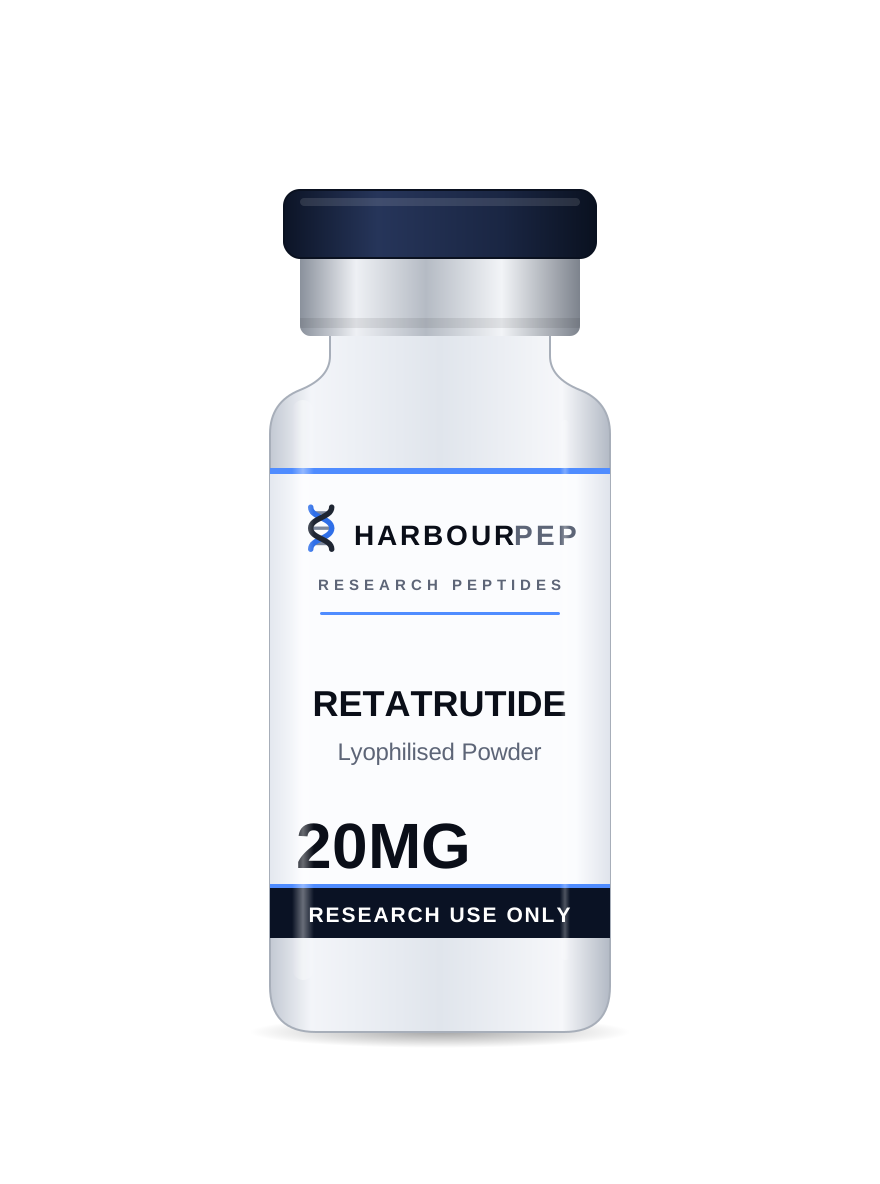
Retatrutide
20MG per vial
Retatrutide (LY3437943) is a synthetic, lipid-conjugated peptide of 39 residues whose backbone derives from GIP and which acts as an agonist at three class B G protein-coupled receptors simultaneously — the GIP, GLP-1 and glucagon receptors. Its stability and pharmacokinetics come from deliberate chemical engineering: 2-aminoisobutyric acid at position 2 resists DPP-4 cleavage, a second Aib sits at position 20 and α-methyl-leucine at position 13, a C20 fatty diacid joined at Lys17 through an AEEA/γGlu linker provides reversible albumin binding, and the chain closes with an extension matching the exendin-4 tail and a C-terminal amide. Its three agonist arms are unequal, with reported cAMP EC50 values of roughly 0.064 nM at GIPR, 0.78 nM at GLP-1R and 5.8 nM at GCGR.
In stock
Available to ship today
Pricing on request
Prices are still being set. Add what you need to your cart and request a quote from there — we will come back with current pricing and availability, usually within one business day.
Research use only. Supplied for in vitro laboratory research. Not a drug, supplement, cosmetic or medical device, not approved by the TGA, and not for administration to humans or animals. See our research use conditions.
Compound signature
From confirmed structure
4731g/mol
Molar mass
335atoms
Heavy atoms
Atomic composition
C221H342N46O68
- C221
- H342
- N46
- O68
Characterised targets
- GIPR
- GLP-1R
- GCGR
Sequence
Y-Aib-QGTFTSDYSI-(αMeLeu)-LDK-K(AEEA-γGlu-C20 diacid)-AQ-Aib-AFIEYLLEGGPSSGAPPPS-NH2
Research applications
The central research question is what the glucagon receptor arm contributes on top of dual incretin agonism: GCGR signalling in hepatocytes raises cAMP and drives PKA-dependent glycogenolysis, gluconeogenesis and fatty acid oxidation, a hepatic component that GLP-1R/GIPR dual agonists do not engage. Cryo-EM structures of the peptide bound to each of the three receptors, reported in 2024, have characterised how a single sequence is accommodated by three different binding pockets, identifying both conserved peptide-receptor contacts and receptor-specific conformations — extracellular loop 1 in particular — that allow one molecule to activate all three. Work in receptor-knockout rodent models and in cell lines expressing each receptor individually has attempted to attribute observed changes in energy expenditure, hepatic lipid handling and glucose flux to specific receptor arms, typically using selective antagonists to isolate one signal at a time. It also serves as the reference triagonist against which newer multi-receptor incretin analogues are profiled.
Formulation and handling
The C20 diacid tail makes this an amphiphilic peptide that self-associates and adsorbs readily onto glass and untreated plastic, with solubility poorest near its isoelectric point — behaviour quite unlike the unmodified peptides in this catalogue. Add solvent down the vial wall and allow it to dissolve without agitation, as the air-liquid interfaces created by vortexing are the principal nucleation site for aggregation; low-binding tubes are worthwhile for dilute working solutions.
Intended use
Retatrutide is supplied exclusively for in vitro and non-clinical scientific research. It is not approved for human or animal therapeutic, diagnostic or medicinal use. All handling and experimentation must be carried out by trained personnel in an appropriately controlled laboratory.
Specification
- Presentation
- Vial
- Labelled strength
- 20MG
- Molecular formula
- C221H342N46O68
- Molar mass
- 4731.4 g/mol
- CAS number
- 2381089-83-2
- Molecular targets
- GIPR, GLP-1R, GCGR
- Appearance
- Lyophilised powder
- Storage
- 2–8 °C sealed, −20 °C long term
Values describe the compound as supplied. Analytical figures for the material in your vial are on that lot’s certificate, not here.
Certificates of analysis
None published yetEvery lot is tested by an independent laboratory and carries its own certificate. Match the lot number printed on your vial to the certificate — a certificate for a different lot tells you nothing about yours.
Slot 1
Awaiting upload
The certificate for the next tested lot will appear here. Until then, ask us for the one matching your vial.
Slot 2
Awaiting upload
The certificate for the next tested lot will appear here. Until then, ask us for the one matching your vial.
Slot 3
Awaiting upload
The certificate for the next tested lot will appear here. Until then, ask us for the one matching your vial.
Also in the range