Move to inspect
GIPR, GLP-1R and GCGR Triple Agonist
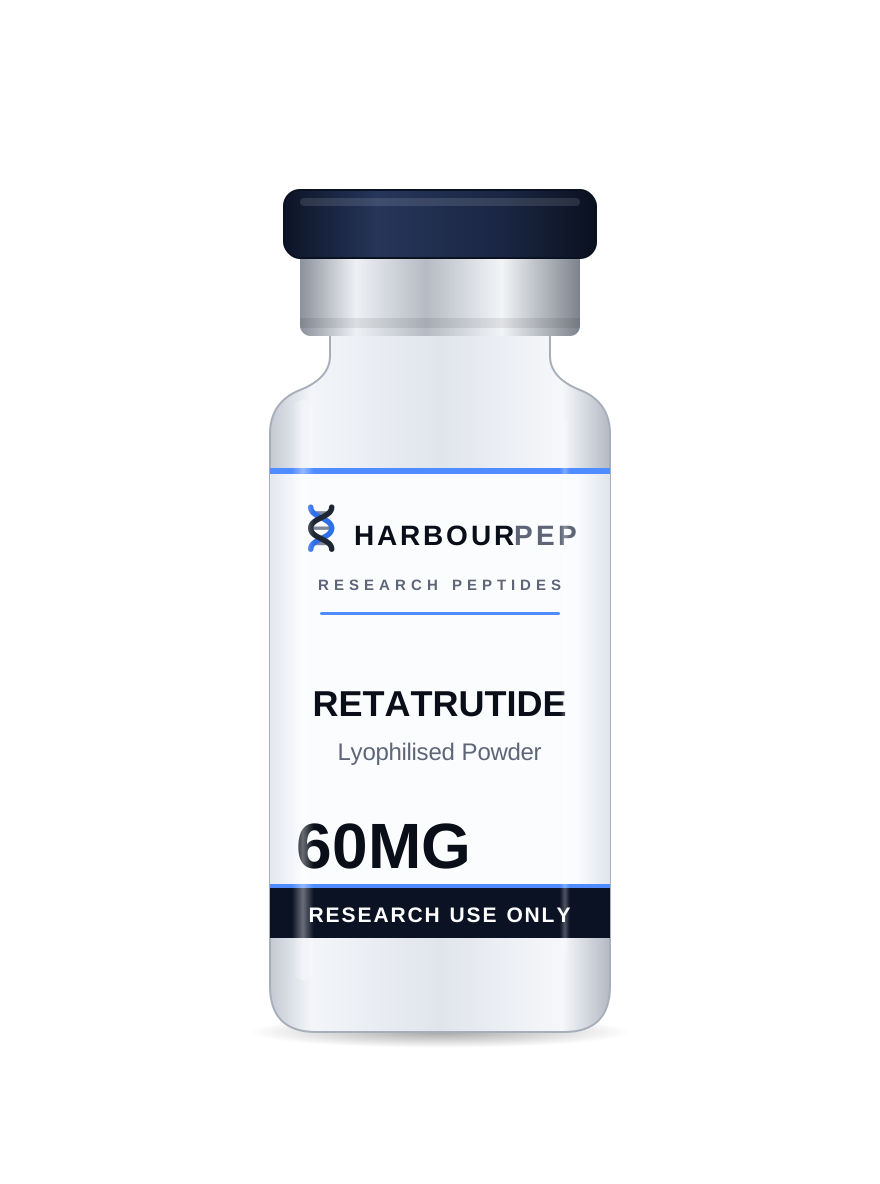
Retatrutide
60MG per vial
Retatrutide (LY3437943) is a synthetic 39-residue lipidated peptide built on a GIP-derived backbone and engineered to agonise three class B G protein-coupled receptors at once: the GIP receptor, the GLP-1 receptor and the glucagon receptor. Three non-proteinogenic residues sit in the chain — 2-aminoisobutyric acid at positions 2 and 20, the first of which blocks DPP-4 cleavage, and α-methyl-leucine at position 13 — while a C20 fatty diacid attached through an AEEA/γGlu linker at Lys17 confers reversible albumin binding, and a C-terminal extension matching the exendin-4 tail terminates in an amide. The triple agonism is imbalanced rather than equipotent: reported cAMP EC50 values are approximately 0.064 nM at GIPR, 0.78 nM at GLP-1R and 5.8 nM at GCGR, an order of magnitude or more separating the strongest and weakest arms.
In stock
Available to ship today
Pricing on request
Prices are still being set. Add what you need to your cart and request a quote from there — we will come back with current pricing and availability, usually within one business day.
Research use only. Supplied for in vitro laboratory research. Not a drug, supplement, cosmetic or medical device, not approved by the TGA, and not for administration to humans or animals. See our research use conditions.
Compound signature
From confirmed structure
4731g/mol
Molar mass
335atoms
Heavy atoms
Atomic composition
C221H342N46O68
- C221
- H342
- N46
- O68
Characterised targets
- GIPR
- GLP-1R
- GCGR
Sequence
Y-Aib-QGTFTSDYSI-(αMeLeu)-LDK-K(AEEA-γGlu-C20 diacid)-AQ-Aib-AFIEYLLEGGPSSGAPPPS-NH2
Research applications
Research centres on what changes when glucagon receptor agonism is layered onto dual incretin agonism, since GCGR signalling in hepatocytes drives cAMP/PKA-dependent glycogenolysis, gluconeogenesis and fatty acid oxidation — a hepatic arm absent from GLP-1R/GIPR dual agonists. Cryo-EM structures of all three retatrutide-bound receptors, published in 2024, have resolved how one sequence is accommodated by three distinct binding pockets, describing a combination of conserved peptide-receptor contacts and receptor-specific conformations — notably in extracellular loop 1 — that permit agonism at all three. In cell systems expressing individual receptors, and in rodent models using receptor knockouts or selective antagonists, studies have sought to deconvolute the three signals and attribute changes in energy expenditure, hepatic lipid handling and glucose flux to specific receptor arms. It is also used as a reference triagonist when profiling newer multi-receptor incretin analogues.
Formulation and handling
This is a lipidated, amphiphilic peptide rather than a plain one: the C20 diacid tail drives self-association and adsorption onto glass and untreated plastic, and solubility is at its worst near the isoelectric point. Reconstitute by running solvent down the vial wall and letting the material dissolve undisturbed rather than vortexing, since air-liquid interfaces generated by shaking are what nucleate aggregation, and use low-binding tubes for dilute working solutions.
Intended use
Retatrutide is supplied exclusively for in vitro and non-clinical scientific research. It is not approved for human or animal therapeutic, diagnostic or medicinal use. All handling and experimentation must be carried out by trained personnel in an appropriately controlled laboratory.
Specification
- Presentation
- Vial
- Labelled strength
- 60MG
- Molecular formula
- C221H342N46O68
- Molar mass
- 4731.4 g/mol
- CAS number
- 2381089-83-2
- Molecular targets
- GIPR, GLP-1R, GCGR
- Appearance
- Lyophilised powder
- Storage
- 2–8 °C sealed, −20 °C long term
Values describe the compound as supplied. Analytical figures for the material in your vial are on that lot’s certificate, not here.
Certificates of analysis
None published yetEvery lot is tested by an independent laboratory and carries its own certificate. Match the lot number printed on your vial to the certificate — a certificate for a different lot tells you nothing about yours.
Slot 1
Awaiting upload
The certificate for the next tested lot will appear here. Until then, ask us for the one matching your vial.
Slot 2
Awaiting upload
The certificate for the next tested lot will appear here. Until then, ask us for the one matching your vial.
Slot 3
Awaiting upload
The certificate for the next tested lot will appear here. Until then, ask us for the one matching your vial.
Also in the range