Move to inspect
N-Acylated GHRH(1-44) Analogue
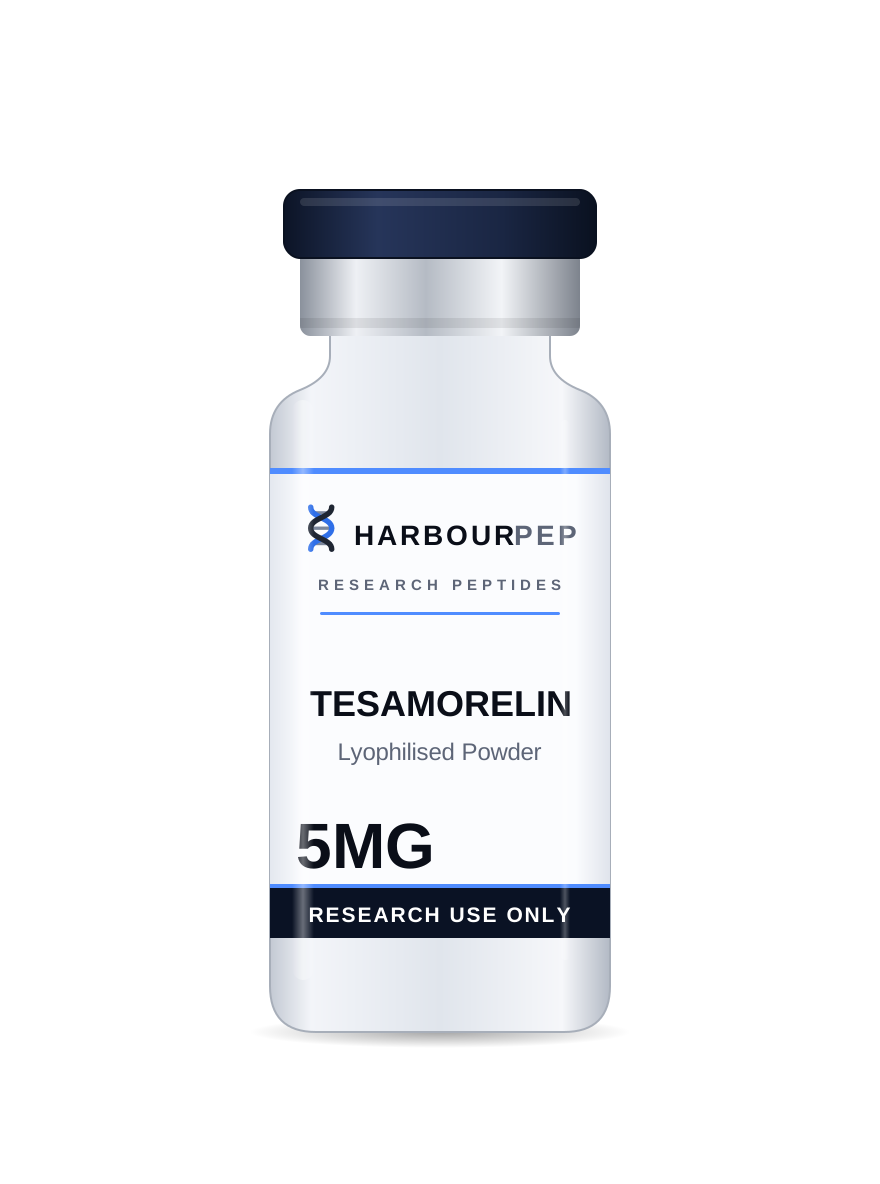
Tesamorelin
5MG per vial
Tesamorelin is a synthetic 44-residue analogue of human growth hormone-releasing hormone, GHRH(1-44)-NH2, bearing a trans-3-hexenoyl group on the alpha-amino nitrogen of the N-terminal tyrosine. That acylation sterically obstructs dipeptidyl peptidase-4, which inactivates native GHRH by removing the Tyr1-Ala2 dipeptide, and is the structural basis for the analogue's reported resistance to that cleavage. It is an agonist at the GHRH receptor, a class B G protein-coupled receptor expressed on anterior pituitary somatotrophs that couples to Gs and raises intracellular cAMP.
Coming soon
Ask us when it returns
Pricing on request
Prices are still being set. Add what you need to your cart and request a quote from there — we will come back with current pricing and availability, usually within one business day.
Research use only. Supplied for in vitro laboratory research. Not a drug, supplement, cosmetic or medical device, not approved by the TGA, and not for administration to humans or animals. See our research use conditions.
Compound signature
From confirmed structure
5136g/mol
Molar mass
361atoms
Heavy atoms
Atomic composition
C221H366N72O67S
- C221
- H366
- N72
- O67
- S1
Characterised targets
- GHRHR
Sequence
trans-3-hexenoyl-YADAIFTNSYRKVLGQLSARKLLQDIMSRQQGESNQERGARARL-NH2
Research applications
Because the peptide acts at the pituitary receptor rather than substituting for growth hormone itself, it has been used as a pharmacological probe of the GH/IGF-1 axis in study designs intended to retain pulsatile secretion rather than override it. Comparative pharmacology has examined its resistance to DPP-4 cleavage and its stability relative to unmodified GHRH, with the hexenoyl cap reported to alter susceptibility to proteolysis rather than receptor engagement. Published pharmacology has followed circulating IGF-1 as the biochemical readout of GHRH-receptor engagement, and has used quantitative imaging — computed tomography measurement of visceral adipose tissue area and magnetic resonance measurement of hepatic fat fraction — as separate endpoints in studies of the axis.
Formulation and handling
Supplied lyophilised; some preparations include a bulking agent such as mannitol, so the visible cake may considerably exceed the peptide content — check the certificate of analysis before calculating concentrations. The N-terminal hexenoyl group adds hydrophobicity relative to unmodified GHRH, and like other large peptides this 44-mer is prone to interfacial aggregation, so add diluent slowly down the vial wall and swirl to dissolve rather than shaking, which encourages foaming.
Intended use
Tesamorelin is supplied exclusively for in vitro and non-clinical scientific research. It is not approved for human or animal therapeutic, diagnostic or medicinal use. All handling and experimentation must be carried out by trained personnel in an appropriately controlled laboratory.
Specification
- Presentation
- Vial
- Labelled strength
- 5MG
- Molecular formula
- C221H366N72O67S
- Molar mass
- 5135.9 g/mol
- CAS number
- 218949-48-5
- Molecular targets
- GHRHR
- Appearance
- Lyophilised powder
- Storage
- 2–8 °C sealed, −20 °C long term
Values describe the compound as supplied. Analytical figures for the material in your vial are on that lot’s certificate, not here.
Certificates of analysis
None published yetEvery lot is tested by an independent laboratory and carries its own certificate. Match the lot number printed on your vial to the certificate — a certificate for a different lot tells you nothing about yours.
Slot 1
Awaiting upload
The certificate for the next tested lot will appear here. Until then, ask us for the one matching your vial.
Slot 2
Awaiting upload
The certificate for the next tested lot will appear here. Until then, ask us for the one matching your vial.
Slot 3
Awaiting upload
The certificate for the next tested lot will appear here. Until then, ask us for the one matching your vial.
Also in the range