Move to inspect
Endogenous VPAC1/VPAC2 Receptor Agonist
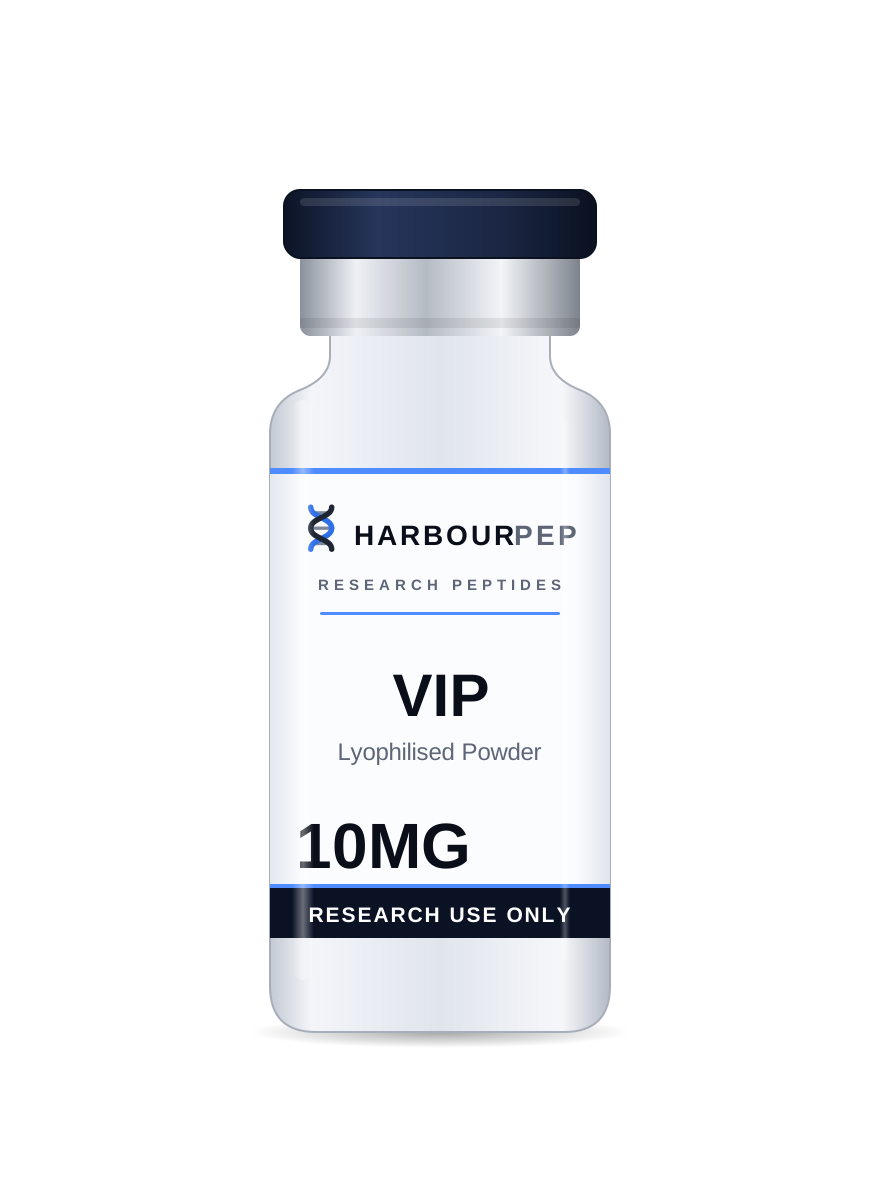
VIP
10MG per vial
Vasoactive intestinal peptide is a 28-residue, C-terminally amidated neuropeptide excised from a precursor that also yields the related peptide PHM-27, and its mature sequence is identical in human, porcine, bovine and rat. It signals through the class B G protein-coupled receptors VPAC1 and VPAC2, both of which couple predominantly to Gs and elevate intracellular cAMP; it also binds PAC1, the PACAP-preferring receptor, but with roughly a thousand-fold lower affinity than PACAP itself, so PAC1 is not a primary site of action. The peptide is strongly basic and adopts a continuous alpha-helix across most of its length when receptor-bound.
In stock
Available to ship today
Pricing on request
Prices are still being set. Add what you need to your cart and request a quote from there — we will come back with current pricing and availability, usually within one business day.
Research use only. Supplied for in vitro laboratory research. Not a drug, supplement, cosmetic or medical device, not approved by the TGA, and not for administration to humans or animals. See our research use conditions.
Compound signature
From confirmed structure
3326g/mol
Molar mass
234atoms
Heavy atoms
Atomic composition
C147H238N44O42S
- C147
- H238
- N44
- O42
- S1
Characterised targets
- VPAC1
- VPAC2
Sequence
HSDAVFTDNYTRLRKQMAVKKYLNSILN-NH2
Research applications
Circadian research has used VIP-null and Vipr2-null tissue to investigate coupling within the suprachiasmatic nucleus, where VIP released by retinorecipient neurons synchronises cellular oscillators via ERK1/2 signalling tuned by its negative regulator DUSP4; slices lacking VIP-VPAC2 communication show damped and desynchronised Per1 rhythms and fewer rhythmic neurons. Alanine-scanning mutagenesis combined with molecular modelling has identified the residues that govern VPAC1 versus VPAC2 selectivity, and that work underpinned the design of receptor-selective agonists. Further lines of investigation have characterised VPAC2-dependent insulin secretion in islet preparations and VIP signalling in T lymphocytes, dendritic cells, and airway and pulmonary vascular smooth muscle.
Formulation and handling
A highly basic peptide that adsorbs strongly to glass and polypropylene, which can cause substantial and silent losses at low working concentrations; low-binding or siliconised labware and a carrier protein in dilute solutions are the usual countermeasures. Methionine at position 17 is oxidation-prone, so prepare working dilutions from freshly reconstituted stock and minimise headspace and air exposure.
Intended use
VIP is supplied exclusively for in vitro and non-clinical scientific research. It is not approved for human or animal therapeutic, diagnostic or medicinal use. All handling and experimentation must be carried out by trained personnel in an appropriately controlled laboratory.
Specification
- Presentation
- Vial
- Labelled strength
- 10MG
- Molecular formula
- C147H238N44O42S
- Molar mass
- 3325.8 g/mol
- Molecular targets
- VPAC1, VPAC2
- Appearance
- Lyophilised powder
- Storage
- 2–8 °C sealed, −20 °C long term
Values describe the compound as supplied. Analytical figures for the material in your vial are on that lot’s certificate, not here.
Certificates of analysis
None published yetEvery lot is tested by an independent laboratory and carries its own certificate. Match the lot number printed on your vial to the certificate — a certificate for a different lot tells you nothing about yours.
Slot 1
Awaiting upload
The certificate for the next tested lot will appear here. Until then, ask us for the one matching your vial.
Slot 2
Awaiting upload
The certificate for the next tested lot will appear here. Until then, ask us for the one matching your vial.
Slot 3
Awaiting upload
The certificate for the next tested lot will appear here. Until then, ask us for the one matching your vial.
Also in the range